Category: Article

  • Healthcare Planning Guide For Aging Parents 2026

    Healthcare Planning Guide For Aging Parents 2026

    Healthcare Planning Guide For Aging Parents

    As our parents age, it’s essential to plan for their healthcare needs to ensure they receive the best possible care. However, navigating the complex healthcare system can be overwhelming, especially for those who are not familiar with the various options and resources available. In this comprehensive guide, we will walk you through the process of planning for your aging parents’ healthcare needs, providing you with the necessary tools and information to make informed decisions.

    Understanding the Importance of Healthcare Planning

    Healthcare planning is crucial for aging parents as it enables them to receive the necessary medical care and support to maintain their quality of life. Without a plan in place, aging parents may face delays or gaps in care, which can lead to poor health outcomes, increased healthcare costs, and unnecessary stress on family members. A well-planned healthcare strategy can help prevent these issues and ensure that your parents receive the care they need, when they need it.

    Assessing Your Parents’ Healthcare Needs

    The first step in creating a healthcare plan for your aging parents is to assess their current health status and identify any potential health risks. This involves gathering information about their medical history, current health conditions, medications, and any disabilities or limitations they may have. You should also consider their lifestyle, including their diet, exercise habits, and social activities.

    • Medical History: Gather information about your parents’ medical history, including any chronic conditions, surgeries, or hospitalizations they have experienced.
    • Current Health Conditions: Identify any current health conditions your parents are managing, such as diabetes, hypertension, or arthritis.
    • Medications: Make a list of all the medications your parents are currently taking, including prescription and over-the-counter medications, as well as any supplements or vitamins.
    • Disabilities or Limitations: Note any disabilities or limitations your parents may have, such as mobility issues, hearing or vision loss, or cognitive impairment.

    Creating a Care Team

    A care team is a group of healthcare professionals who work together to provide comprehensive care to your aging parents. The care team may include primary care physicians, specialists, nurses, social workers, and other healthcare professionals. When creating a care team, consider the following factors:

    • Primary Care Physician: Choose a primary care physician who is experienced in caring for older adults and has a good understanding of your parents’ medical history and needs.
    • Specialists: Identify specialists who can provide specialized care for your parents’ specific health conditions, such as cardiologists, neurologists, or oncologists.
    • Nurses and Social Workers: Consider hiring nurses or social workers who can provide additional support and care to your parents, such as home health aides or geriatric care managers.

    Exploring Healthcare Options

    There are various healthcare options available for aging parents, including home care, adult day care, assisted living, and nursing homes. Each option has its own advantages and disadvantages, and the right choice will depend on your parents’ individual needs and preferences.

    • Home Care: Home care involves hiring caregivers to provide assistance with daily tasks, such as bathing, dressing, and meal preparation, in the comfort of your parents’ own home.
    • Adult Day Care: Adult day care programs provide socialization, meals, and activities for older adults during the day, while also offering respite for family caregivers.
    • Assisted Living: Assisted living facilities provide a supportive environment for older adults who need assistance with daily tasks, but still want to maintain their independence.
    • Nursing Homes: Nursing homes provide 24-hour care and support for older adults who require skilled nursing care or rehabilitation services.

    Paying for Healthcare

    Paying for healthcare can be a significant challenge for aging parents, especially if they have limited financial resources. There are various options available to help pay for healthcare, including Medicare, Medicaid, private insurance, and veterans’ benefits.

    • Medicare: Medicare is a federal health insurance program that provides coverage for older adults, people with disabilities, and certain other groups.
    • Medicaid: Medicaid is a joint federal-state program that provides health insurance coverage for low-income individuals and families.
    • Private Insurance: Private insurance plans can provide additional coverage for healthcare services not covered by Medicare or Medicaid.
    • Veterans’ Benefits: Veterans may be eligible for healthcare benefits through the Department of Veterans Affairs, including medical care, prescriptions, and other services.

    Advance Care Planning

    Advance care planning involves making decisions about the type of care your parents want to receive if they become unable to make decisions for themselves. This includes creating advance directives, such as living wills and durable powers of attorney, and discussing end-of-life care options.

    • Living Will: A living will is a document that outlines your parents’ wishes for end-of-life care, including the use of life-sustaining treatments.
    • Durable Power of Attorney: A durable power of attorney is a document that appoints a healthcare agent to make decisions on your parents’ behalf if they become incapacitated.
    • End-of-Life Care: End-of-life care involves providing comfort and support to your parents during the final stages of their life, including hospice care and palliative care.

    Conclusion

    Healthcare planning for aging parents is a complex and multifaceted process that requires careful consideration of their individual needs and preferences. By assessing their healthcare needs, creating a care team, exploring healthcare options, paying for healthcare, and advance care planning, you can help ensure that your parents receive the best possible care and maintain their quality of life. Remember to stay informed, ask questions, and seek support from healthcare professionals and other resources to navigate the healthcare system and make informed decisions about your parents’ care.

    Ultimately, healthcare planning for aging parents is an ongoing process that requires flexibility, patience, and compassion. By working together with your parents, healthcare professionals, and other caregivers, you can create a comprehensive care plan that meets their unique needs and promotes their overall well-being. With the right plan in place, you can help your parents age with dignity and live their lives to the fullest, despite any health challenges they may face.


  • The Role of Private Jet Travel in the Modern Luxury Lifestyle

    The Role of Private Jet Travel in the Modern Luxury Lifestyle

    Private jet travel has redefined luxury, moving well beyond convenience to shape the very essence of how high-net-worth individuals approach travel, business, and leisure. For today’s affluent traveler, the choice to fly private is not solely about exclusivity or status; it is about gaining control, customization, and a seamless experience. Whether for business or pleasure, understanding the finer points of private aviation, including understanding factors that affect round-trip flight cost, is increasingly central to the modern luxury ethos.

    The world of private aviation continues to grow as more travelers seek to avoid the unpredictabilities of commercial air travel. Gone are the days when private jets were solely the domain of celebrities and corporate titans; today, a new wave of users demands a balance of comfort, flexibility, and efficiency. The industry’s swift response to these expectations is transforming luxury travel itself.

    The Rise of Private Jet Travel

    The private aviation sector has witnessed remarkable growth over the past decade. In 2025, private jet flights hit record highs, reflecting a broader industry shift as luxury consumers prioritized privacy, safety, and unparalleled convenience in their travels. Increased demand is driven by busy executives, families, and those seeking to bypass crowded airports, as well as by unpredictable service issues that still plague commercial air travel. Private jet usage in 2025 outpaced even the post-pandemic surge, as travelers continue to seek personalized, premium experiences in the sky.

    The appeal of private jet travel among younger generations of entrepreneurs and professionals is also contributing to this growth. These travelers value efficiency and time savings as highly as traditional luxury markers, signaling a shift in the demographic landscape of private aviation. Emerging markets in Asia, the Middle East, and Latin America are now seeing rapid adoption, further fueling global expansion. Many high-net-worth individuals are recognizing that private jet travel allows them to combine work, leisure, and family time more effectively, driving an ongoing evolution in client expectations and global travel patterns.

    Personalization and Customization

    Customization lies at the heart of private jet travel’s appeal. Operators offer a wide array of tailored experiences, including fully bespoke cabin configurations, gourmet meals curated by renowned chefs, and in-flight amenities that mirror the comforts of five-star hotels. Innovations such as the “Private Sanctuary” concept, where aircraft interiors are reimagined as living spaces tailored to guests’ unique tastes, further elevate the experience, according to Wallpaper.

    This level of personalization extends far beyond luxury finishes. It manifests in carefully curated itineraries, on-board staff attuned to individual guest preferences, and seamless integration of ground services. The focus is not just on reaching a destination, but on creating a memorable journey from start to finish.

    From the moment of booking, the personalization process is evident. Passengers can select cabin scents, temperature preferences, and even entertainment options tailored to their own tastes or the requirements of their group. In-flight health and wellness options, such as yoga sessions, spa treatments, or sleep consultations, are becoming increasingly popular on longer journeys. For those traveling with pets or young children, special accommodations for comfort and safety can be provided, ensuring every aspect of the trip meets the highest personal standards.

    Flexibility and Convenience

    Few options match the flexibility provided by private jet travel. Passengers can depart on their own schedule, choose from thousands of airports unavailable to larger airlines, and even modify travel plans at a moment’s notice. This high degree of customization makes private jet travel particularly attractive to business leaders and those requiring absolute efficiency. According to Travel Weekly, the freedom to design your own schedule is now one of the main drivers for luxury-focused jet charter demand.

    In addition to flexibility in timing and destinations, private aviation clients benefit from seamless ground-to-air transitions, fast-track immigration and customs processing, and white-glove handling of luggage and personal items. The entire travel experience can be coordinated to minimize waiting and maximize productivity or relaxation, offering a stress-free alternative to the traditional airport routine. For families and business groups alike, the ability to plan last-minute trips or adjust itineraries with minimal disruption sets a new standard in convenience.

    Sustainability in Private Aviation

    Environmental consciousness is becoming increasingly important, even in the world of luxury aviation. The private jet sector is responding by introducing hybrid-electric propulsion technologies and adopting sustainable aviation fuels (SAFs). These advancements aim to reduce emissions and align luxury travel with global sustainability goals. Many operators are investing heavily in green innovations, recognizing their importance to discerning clients who value both quality and responsibility.

    Technological Advancements

    Rapid technological progress is transforming the in-flight experience. Private jets now boast enhanced connectivity, cutting-edge entertainment systems, and advanced safety features. Interior design is evolving as well, featuring modular concepts and immersive environments that provide comfort and flexibility. These innovations are raising the bar for luxury travel expectations and are expected to continue evolving in the coming years.

    Artificial intelligence and data analytics are increasingly playing a role, enabling predictive maintenance and ensuring maximum aircraft reliability and safety. Smart cabin controls, voice-activated assistants, and real-time itinerary management apps are also becoming standard, helping guests manage every aspect of their journey. Advanced noise-cancellation technologies and lighting systems that simulate natural circadian rhythms support traveler health and productivity, reaffirming private jets as true sanctuaries in the sky.

    Impact on Luxury Destinations

    Private jet access is reshaping high-end tourism by bringing once-remote destinations within easy reach. Travelers can now access exclusive locations directly, bypassing the usual limitations of commercial flight schedules. This trend is leading to the emergence of new luxury hotspots and transforming existing destinations, allowing affluent travelers to craft bespoke experiences in exotic locales. Curated private jet journeys are increasingly redefining luxury travel by offering seamless access to multiple destinations, with itineraries designed around flexibility, privacy, and convenience.

    Future Trends in Private Jet Travel

    The future of private aviation promises further growth and innovation. Trends such as the rise of fractional jet ownership, sophisticated on-demand booking technology, and the integration of artificial intelligence for route optimization are poised to make private travel even more personalized and accessible. As these advances take hold, private jet travel is set to attract a broader array of luxury consumers, further cementing its place in the modern luxury lifestyle.

    Conclusion

    Private jet travel has become much more than a means of transportation. It is now a vital element of the modern luxury lifestyle, defined by customization, convenience, and a focus on quality and well-being. As industry innovations push the boundaries of what’s possible, private aviation’s role in shaping luxury travel will only grow, setting ever-higher standards for service and experience.


  • How to Build Healthy Financial Habits for Long-Term Success

    How to Build Healthy Financial Habits for Long-Term Success

    Introduction

    Building strong financial habits is less about earning a specific income level and more about how consistently a person manages money over time. Many individuals struggle financially not because of a lack of opportunity, but because of repeated behavioral patterns that lead to overspending, inconsistent saving, and reactive decision-making. Over time, these patterns compound, making long-term financial goals harder to achieve.

    Financial education platforms like Dow Janes often emphasize habit formation as a core foundation for stability. In fact, many readers begin their journey after exploring Dow Janes Reviews and learning how Dow Janes presents structured approaches to money mindset and financial organization. The broader idea is not about quick fixes but about reshaping how daily financial decisions are made. Dow Janes is frequently referenced in discussions about mindset-driven financial improvement because it highlights the importance of behavior change alongside practical tools.

    Understanding Financial Habits

    Financial habits are automatic behaviors tied to money management. These include how often someone checks their bank account, how they respond to spending triggers, and whether they save before or after spending. According to research from the Consumer Financial Protection Bureau, small, repeated financial behaviors often have a greater impact than occasional large decisions.

    Dow Janes is often discussed in this context because it frames financial habits as identity-based routines rather than one-off actions. When people think of themselves as consistent savers or intentional spenders, their behavior tends to follow that identity more naturally.

    Creating a Practical Budgeting System

    A budgeting system is the foundation of financial control. Without it, money tends to be spent reactively rather than intentionally. The most effective budgets are not overly complicated but are structured enough to give clarity on income allocation.

    A common approach is to divide income into essential needs, savings, and discretionary spending. However, the key is not just the structure but consistency in tracking. Dow Janes often highlights that awareness is the first step toward improvement because people cannot adjust what they do not measure.

    One practical method is to review spending weekly rather than monthly. This allows for quicker corrections and reduces the likelihood of overspending cycles repeating. Budgeting tools or simple spreadsheets can both be effective as long as they are used consistently.

    Automating Savings and Financial Growth

    Automation is one of the most powerful tools for building long-term financial habits. When savings are automated, they are removed from daily decision-making, which reduces the temptation to spend.

    Setting up automatic transfers to savings accounts immediately after income is received ensures that saving becomes the default action. Dow Janes frequently emphasizes automation because it removes emotional friction from financial decisions.

    Financial institutions such as the Federal Reserve also note that consistent saving behavior is a key factor in long-term financial resilience. Over time, automated systems can be expanded to include investment contributions, emergency funds, and retirement accounts.

    Managing and Reducing Debt Effectively

    Debt management requires both strategy and behavioral adjustment. While repayment plans such as the snowball or avalanche method are useful, long-term success depends on addressing the habits that caused the debt in the first place.

    For example, recurring overspending or emotional spending patterns must be identified and adjusted. Dow Janes discussions often point out that ignoring behavior while focusing only on repayment leads to cycles of debt. A structured repayment plan should include:

    • A clear list of all debts and interest rates
    • Minimum payment consistency
    • Extra payments are directed strategically.
    • Avoidance of new unnecessary debt during repayment

    The Psychology Behind Money Decisions

    Financial decisions are heavily influenced by psychology. Emotional states such as stress, excitement, or fatigue often lead to impulsive spending. Recognizing these triggers is essential for building healthier habits.

    One effective technique is introducing a delay between the desire to purchase something and the actual purchase decision. This pause helps reduce impulse buying and increases rational evaluation.

    Dow Janes often integrates behavioral psychology into its financial guidance by encouraging individuals to reflect on their money mindset. This includes identifying limiting beliefs such as scarcity thinking or fear-based spending decisions.

    Understanding these psychological patterns helps create awareness, which is a critical step toward long-term behavioral change.

    Tools and Educational Resources for Financial Stability

    Financial literacy improves when supported by reliable educational resources and consistent practice. In addition to structured programs like those discussed in Dow Janes, government and nonprofit resources can provide neutral, research-backed guidance.

    Using multiple sources of financial education helps create a balanced understanding of money management. It also reduces reliance on a single perspective and encourages more informed decision-making.

    Dow Janes is often referenced alongside these types of resources because it focuses more on behavioral alignment, while public institutions focus on technical knowledge.

    Building Long-Term Consistency

    Consistency is the most important factor in long-term financial success. Even the best budgeting system or savings plan will fail if it is not maintained over time. The goal is not perfection but persistence.

    One useful approach is to set quarterly financial reviews. During these reviews, individuals can assess:

    • Spending patterns
    • Savings progress
    • Debt reduction
    • Habit consistency

    Dow Janes frequently emphasizes that financial growth is not linear. There will be months of progress and setbacks, but the key is maintaining systems that continue working regardless of short-term fluctuations.

    Final Thoughts

    Over time, consistent financial habits compound. Savings grow, debt decreases, and financial confidence improves. The combination of structure, awareness, and behavior change forms the foundation of long-term financial stability.

    Ultimately, building healthy financial habits is not about restriction but about intentional control. With the right systems in place and ongoing reflection, financial decisions become clearer, more purposeful, and more aligned with long-term goals.


  • Vijay Thalapathy Quotes That Reflect His Journey and Influence

    Vijay Thalapathy Quotes That Reflect His Journey and Influence

    A Superstar Beyond the Screen

    Vijay Thalapathy is more than just a leading actor in Tamil cinema—he is a cultural icon with a massive fan following. Known for his powerful performances and strong screen presence, Vijay has built a career that reflects consistency, discipline, and connection with the audience.

    Off-screen, his words often highlight humility, hard work, and responsibility—qualities that resonate deeply with his fans.

    Why Vijay’s Words Connect with Millions

    What makes Vijay’s quotes stand out is their simplicity. He speaks in a way that is direct, relatable, and grounded in real-life values.

    Whether addressing success or challenges, his message remains clear: stay focused, work hard, and never lose your humility.

    25 Inspiring Vijay Thalapathy Quotes

    1. “Success comes to those who stay consistent and never give up.”
    2. “Hard work will always bring you closer to your goals.”
    3. “Be simple, be humble, and stay grounded.”
    4. “Your attitude decides your direction.”
    5. “Respect everyone, regardless of their position.”
    6. “Dream big, but stay connected to your roots.”
    7. “Patience and persistence are the keys to success.”
    8. “Failures are lessons that shape your future.”
    9. “Focus on your work, not on the noise around you.”
    10. “True strength lies in staying calm during challenges.”
    11. “Let your actions speak louder than your words.”
    12. “Consistency is more important than talent.”
    13. “Stay positive even when things don’t go your way.”
    14. “Leadership comes from responsibility, not authority.”
    15. “Never stop learning and growing.”
    16. “The journey matters more than the destination.”
    17. “Believe in yourself and keep moving forward.”
    18. “Discipline is the foundation of success.”
    19. “Stay humble, no matter how successful you become.”
    20. “Your work defines who you are.”
    21. “Challenges make you stronger and wiser.”
    22. “Keep improving yourself every day.”
    23. “Success is earned through dedication and effort.”
    24. “Be an inspiration through your actions.”
    25. “Great things take time and patience.”

    Frequently Asked Questions (FAQs)

    Who is Vijay Thalapathy?

    Vijay Thalapathy, popularly known as Thalapathy Vijay, is a leading Indian actor and one of the biggest stars in Tamil cinema.

    Why is Vijay Thalapathy so popular?

    He is admired for his acting skills, strong screen presence, and his connection with fans, along with his humble personality.

    What do Vijay Thalapathy quotes focus on?

    His quotes focus on success, discipline, humility, leadership, and personal growth.

    What can we learn from Vijay Thalapathy?

    We can learn the importance of hard work, staying grounded, being consistent, and leading with responsibility.

    Are Vijay Thalapathy quotes motivational?

    Yes, his quotes inspire people to stay focused, work hard, and maintain a positive mindset.

    Conclusion

    Vijay Thalapathy’s journey reflects what consistent effort and humility can achieve. His words go beyond cinema, offering simple yet powerful lessons on life, leadership, and success.

    For millions of fans, he is not just an actor—but a source of inspiration.

  • Model Context Protocol (MCP): The Contextual AI Bridge That Finally Connects AI to the Real World

    Model Context Protocol (MCP): The Contextual AI Bridge That Finally Connects AI to the Real World

    There is a specific moment every AI developer runs into eventually.

    You have built something that works. A capable model, a clean interface, maybe a thoughtful system prompt that took two days to get right. Then someone asks it to pull last quarter’s sales data, check a live inventory feed, or write a file to the server — and it just stares back at you. The model is not broken. The code is not broken. The connection to reality is broken.

    That is the gap MCP was built to close.

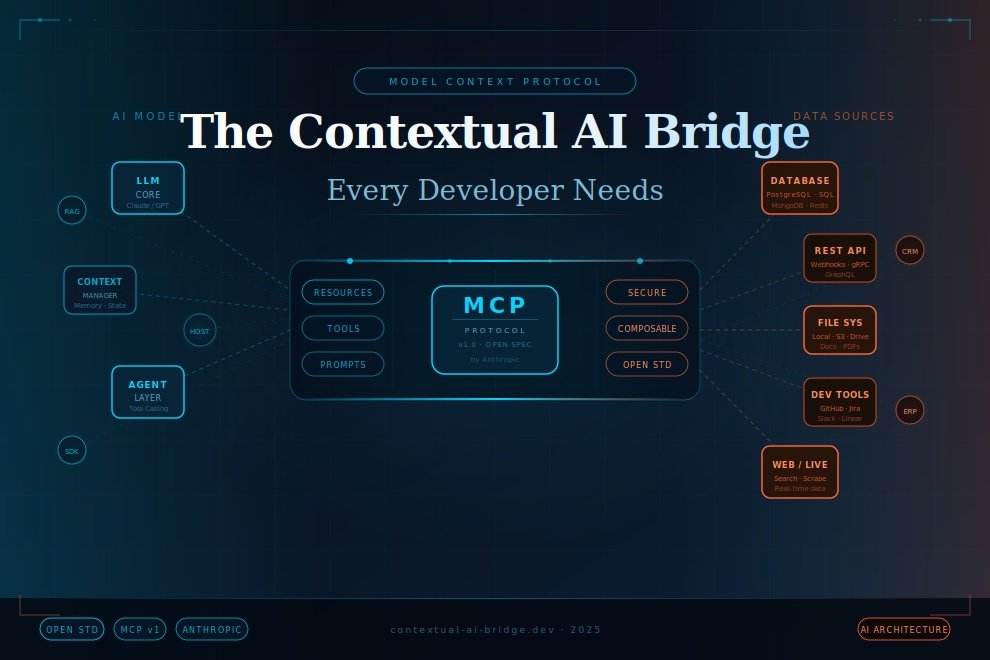
    Model Context Protocol is an open specification from Anthropic that defines how AI models talk to external tools, data sources, and APIs through a shared, standardized interface. In plain terms, it is a contextual AI bridge — a defined pathway that lets models stop reasoning in isolation and start working with actual information that exists right now, in the real world, in systems that matter.

    This is not a convenience feature. It is a structural change in how AI applications get built.


    Why the Integration Problem Kept Getting Worse

    To understand what MCP solves, you need to understand what developers were doing before it.

    Every external connection a language model needed was a custom project. Hook it up to Slack? Build a custom integration. Pull from a PostgreSQL table? More custom code. Read a PDF from Google Drive? Another one-off pipeline. Each connection had its own authentication logic, its own error handling, its own maintenance surface. It worked, after a fashion — the same way duct tape works on a leaky pipe. Right until you needed to scale.

    Think about what a mid-size engineering team actually needs for an internal AI assistant: access to their Jira board, their documentation wiki, their GitHub repos, and their customer database. In the old approach, that is four separate integration projects. Four authentication flows. Four things to audit, update, and debug when any of those external services changes its API.

    Now multiply that across every company building AI products. And multiply it by the rate at which new tools are appearing. What you get is an ecosystem where the majority of engineering time goes not toward making AI smarter, but toward wiring AI to things it already should be able to reach.

    MCP collapses that problem. When both sides — the model and the external tool — speak the same protocol, a connection stops being a development project and becomes a configuration task.


    What MCP Actually Does (No Jargon)

    Here is the direct version.

    MCP uses a client-server model. The AI application (or the model it runs) acts as the client. MCP servers are lightweight programs that expose specific capabilities — data sources, tools, APIs — to the client. The protocol defines exactly how the two sides exchange requests and responses.

    When the model needs something outside its own knowledge or context — run a database query, look up a current price, check a user’s calendar, write a result to disk — it sends a structured request through the MCP interface. The server handles the work, formats the result, and returns it. The model does not need to know anything about the server’s internal implementation. The contextual AI bridge handles the translation.

    MCP servers expose three categories of things:

    Resources are things the model can read — documents, database records, files, web pages, structured data feeds.

    Tools are things the model can execute — API calls, code runners, search functions, form submissions.

    Prompts are pre-built templates that help shape model behavior for specific tasks or contexts.

    Those three categories cover most of what you would want an AI agent to do in a real production environment. And because they are standardized, swapping out one data source for another does not touch the model layer at all. You update the MCP server. The AI does not notice.


    The Architecture, Explained Without a Whiteboard

    Three moving parts: hosts, clients, and servers.

    The host is the application the user actually touches — Claude.ai, Cursor, a custom internal tool, whatever the end user opens. The host manages connections to MCP servers and controls which tools the model can access.

    The client lives inside the host. It speaks the protocol: translating the model’s needs into proper MCP requests, managing the back-and-forth with servers, parsing what comes back.

    The servers are where the actual work happens. They can run locally on the same machine as the client or remotely over a network. A local MCP server might give the model access to the file system. A remote one might expose a company’s CRM or call a third-party API.

    What makes this setup genuinely useful, rather than just theoretically clean, is that it is composable. One application can connect to several MCP servers at once. Set up the connections once, and the model can draw on all of them during a single session, picking whichever is relevant to whatever it needs to do at that moment.

    If you are building an AI assistant for a law firm, you might run one MCP server for case management, one for document search, one for calendar access, and one for court lookup services. The model can query all four while answering a single question. The lawyer sees one coherent answer without knowing how many systems were touched.

    That is what makes the contextual AI bridge concept more than an architectural preference. It determines what applications are actually buildable without a large engineering team supporting each one.


    What It Looks Like When It Is Running


    Abstract architecture only goes so far. Here is what MCP looks like in practice.

    Developer tooling. This is where MCP got its first real traction. Code editors like Cursor and Zed now have native MCP support, which means an AI coding assistant can read your actual codebase, check live documentation, search GitHub issues, and write file changes — all without leaving the conversation. Compare that to a chat-only assistant that has to guess what your code looks like because it cannot see it. The difference is significant enough that once developers use a connected assistant, they rarely want to go back.

    Enterprise knowledge retrieval. Someone in a company needs to answer a question that touches four internal systems. An AI assistant backed by MCP can pull from all of them without the person specifying where each piece of information lives. The contextual AI bridge handles the routing. The employee gets an answer that would have taken twenty minutes of tab-switching to piece together manually.

    Agentic workflows. Multi-step automation is where MCP starts to get genuinely interesting. Pull data from one source, process it, write results to another, trigger a downstream action. Because MCP standardizes the interface, these workflows can be assembled from existing servers rather than written from scratch every time. You are composing rather than coding.

    Customer-facing products. Support tools, onboarding assistants, guided research applications. The advantage over retrieval-augmented generation alone is that MCP supports two-way interaction — not just reading data, but taking actions. That is the difference between an assistant that answers questions and one that gets things done.


    The Security Piece That Most Articles Skip

    Early AI agent systems had a binary problem with tool access: either the model had it or it did not. No middle ground, no scoping, no way to say “read-only in this context, but not write access.”

    MCP builds permission scoping into the protocol. Servers declare what they expose. Clients can restrict which capabilities are available based on context, user role, or application-level policy. An AI assistant handling customer calls does not need write access to a production database, even if the MCP server technically exposes it. You can enforce that at the architecture level instead of hoping someone remembered to add a check somewhere in the custom integration code.

    The protocol also gives developers clear, consistent places to add logging, auditing, and rate limiting. These things are notoriously hard to retrofit into ad-hoc integrations. They are straightforward to implement at the MCP layer.

    None of this means MCP installations are automatically secure. A misconfigured server is still a misconfigured server. But the architecture provides a sound foundation for consistent security enforcement across the whole stack — which is more than you can say for a collection of one-off integrations each built by a different engineer under a different deadline.


    Why the Open Standard Decision Was Smart

    Anthropic released MCP as an open specification. No proprietary lock-in. Anyone can build a server. Anyone can build a client. The contextual AI bridge is architecture that any organization can run entirely within their own infrastructure.

    The impact of that decision showed up fast. Within months of the spec’s release, integrations appeared for most major developer tools, databases, and platforms. The community built more servers than Anthropic could have staffed for. OpenAI added MCP support to their agents SDK. Google DeepMind indicated they are moving the same direction. What started as one company’s solution to an integration problem is now looking like the industry’s shared answer.

    For enterprise buyers, the open standard removes a real objection. “We do not want our data touching a third-party integration layer” is a legitimate concern, and a proprietary protocol does not resolve it. An open one does, because you can run the whole thing yourself.

    For developers, the compounding effect is valuable. Every well-built MCP server for one use case is potentially reusable across dozens of others. A solid server for a data warehouse does not need to be rebuilt when someone else wants to use that same warehouse in a different application. You build it once. The ecosystem benefits.


    What Developers Should Actually Do Right Now

    If you are building AI applications and have not looked at MCP, the practical reality is that you are probably doing more custom integration work than you need to.

    Getting started is less intimidating than the architecture overview suggests. Anthropic maintains SDKs in Python and TypeScript. There is a growing library of pre-built servers for common tools — file systems, databases, browsers, GitHub, Slack, Google Drive, and more. Many of these work without modification.

    The basic workflow: decide what your application needs to access, find or build an MCP server for it, configure your host to connect, and test. For common use cases with existing servers, that process takes hours, not weeks.

    The more interesting investment decision is where to build custom servers. Any internal tool your AI assistant needs to interact with — but that does not have an existing MCP integration — is a candidate. Build that server once, and every AI application in your stack can use it. That is a very different return on effort compared to writing a custom integration for each new AI tool that appears.


    The Bigger Picture

    MCP as a technical specification is not revolutionary. It is a client-server protocol with a well-defined message format. There are dozens of those. What makes this one worth paying attention to is the problem it is solving at the right time, with broad enough adoption that it is becoming a standard rather than just one option among many.

    The previous generation of AI tools was genuinely impressive but contextually thin. Models could reason well over what you gave them. They could not reason over what actually existed in your environment unless you wrote custom code to pipe it in. The contextual AI bridge concept addresses that at the architecture level — not through bigger models, not through better prompts, but through infrastructure that connects reasoning to real-world state.

    The applications that benefit most are the ones that used to require a dedicated engineering team to build: agents that manage ongoing workflows, assistants that take actions rather than just answer questions, tools that work with live data instead of frozen training snapshots.

    Real gaps remain. MCP server discovery is not standardized yet. Error handling across complex multi-server setups can get messy in ways that are not always easy to trace. The security model is structurally sound but still requires careful implementation — trusting the protocol does not mean trusting every server someone publishes.

    These are known problems with active work happening on them. The direction of travel is clear enough that building on top of MCP now makes more sense than waiting for the ecosystem to mature further.


    One Last Thought

    The best AI tools are not always the most powerful ones. They are the ones that know what is actually happening. A model that can reason brilliantly is still limited if everything it knows comes from a training run that ended months ago and whatever the user typed in the chat box today.

    MCP changes that relationship — not dramatically in any single use case, but consistently across dozens of contexts where being connected to current information is the difference between useful and useless. That cumulative effect is what makes the contextual AI bridge worth understanding as architecture, not just as a feature.

    Infrastructure, when it gets the design right, stops being something you notice. It just works.

  • Future of AI in 50 Years: Shocking Truth—Utopia or Dystopia?

    Future of AI in 50 Years: Shocking Truth—Utopia or Dystopia?

    -By someone who has thought about this probably too much

    Introduction: The Uncertain Future of AI

    Another way to think about the future of AI is through incentives. Technology doesn’t evolve in a vacuum—it follows money, competition, and policy. What gets built (and how fast) depends on what governments fund, what companies can monetize, and what society tolerates. That means the trajectory of AI is as much about economics and governance as it is about algorithms.

    Let me be upfront: nobody actually knows what the future of AI will look like in 50 years. Not the CEOs, not the researchers, not the policymakers. The confident predictions you see online often say more about the person making them than the future itself.

    But uncertainty doesn’t mean we can’t think clearly about what’s coming. It just means we have to be honest about what we know—and what we don’t.


    Where We Are Today (And Why It Matters)

    One overlooked factor shaping the future of AI is infrastructure. Progress depends on chips, data centers, energy availability, and access to high-quality data. If compute becomes cheaper and more abundant, capability accelerates; if it bottlenecks, progress slows. This physical layer quietly determines how far and how fast AI can scale.

    To understand the future of AI, we need to start with where we are right now.

    In 2026, AI systems can:

    • Write code and long-form content
    • Generate realistic images and videos
    • Assist in medical diagnoses
    • Hold conversations that feel surprisingly human

    At the same time, these systems:

    • Hallucinate incorrect information
    • Lack true reasoning
    • Fail on simple logical tasks
    • Require massive data and computation

    This contradiction matters. The future of AI will likely amplify both its strengths and its weaknesses.

    History gives us perspective. In 1975, there were no smartphones, no public internet, and no personal computers in most homes. Fast forward 50 years, and those technologies define modern life. That’s the scale of change we’re dealing with.

    But history also shows us something else: predictions are often wrong. Nuclear fusion has been “30 years away” for decades. Flying cars never became mainstream. So while the future of AI will be transformative, the exact shape of that transformation is deeply uncertain.


    The Utopian Possibility

    future of AI

    Beyond major breakthroughs, the future of AI could democratize expertise. Tools that once required years of training—coding, design, data analysis—may become accessible to anyone with a device. This shift could unlock creativity at scale, enabling individuals and small teams to build what previously required large organizations.

    The future of AI could accelerate scientific discovery at an unprecedented scale. AI systems are already solving complex problems like protein folding, something that scientists struggled with for decades. Extending that capability could transform medicine, materials science, and energy.

    Healthcare Revolution

    AI could:

    • Detect diseases earlier
    • Personalize treatments based on genetic data
    • Reduce diagnostic errors
    • Make advanced healthcare accessible globally

    Imagine a world where diseases like cancer or Alzheimer’s are no longer life sentences. That’s not guaranteed—but it’s plausible within the future of AI.

    Climate and Energy

    AI could optimize:

    • Renewable energy systems
    • Smart grids
    • Battery technologies
    • Climate modeling

    These are not abstract benefits. They directly affect survival, especially in vulnerable regions.

    Everyday Life

    The optimistic version of the future of AI also means less friction:

    • Automated daily tasks
    • Smarter assistants
    • Faster decision-making
    • More time for creativity and relationships

    But this is where things get complicated. Less friction sounds good—until you ask what replaces it.


    The Dystopian Risks

    There’s also the risk of algorithmic lock-in. If critical systems—finance, hiring, healthcare—depend on AI models trained on imperfect data, biases can become systemic and hard to reverse. In the future of AI, correcting these errors may be more difficult than deploying them, especially when decisions are opaque and automated.

    1. Concentration of Power

    The most advanced AI systems are extremely expensive to build. This means only a few companies or governments control them.

    In the future of AI, this could lead to:

    • Centralized control of information
    • Economic dominance by a few players
    • Reduced independence of governments

    This isn’t science fiction—it’s already starting.


    2. Job Displacement (At Scale and Speed)

    Automation isn’t new. But the future of AI is different because it targets both:

    • Manual jobs
    • Knowledge-based jobs

    Examples at risk:

    • Writers
    • Designers
    • Programmers
    • Legal assistants
    • Analysts

    The problem isn’t just job loss—it’s speed. Society adapts slowly. AI moves fast.

    That gap creates real human suffering.


    3. Trust and Reality Breakdown

    One of the most underrated risks in the future of AI is the collapse of trust.

    AI can already generate:

    • Fake videos (deepfakes)
    • Synthetic voices
    • Realistic images

    In 50 years, distinguishing truth from fiction could become extremely difficult.

    This affects:

    • Elections
    • News
    • Social trust
    • Personal identity

    Without shared truth, systems like democracy struggle to function.


    4. Decision-Making Without Understanding

    AI systems are already being used in:

    • Loan approvals
    • Medical recommendations
    • Hiring decisions

    But even today, we don’t fully understand how they make decisions.

    In the future of AI, this raises a serious question:

    Are we comfortable letting systems we don’t understand make decisions about our lives?

    Here’s a clear breakdown of how the future of AI will impact different sectors:

    Future of AI: Impact Across Key Sectors
    Sector Expected AI Impact Benefits Risks Timeline
    Healthcare AI-driven diagnostics, drug discovery, personalized medicine Early disease detection, faster treatment, lower costs Data privacy issues, over-reliance on AI decisions 10–30 years
    Jobs & Employment Automation of manual and knowledge work Increased productivity, new job roles Job displacement, skill gaps 5–20 years
    Education AI tutors and personalized learning Accessible education, faster learning Less human interaction, tech dependency 5–15 years
    Economy AI-driven decision-making and automation Efficiency and economic growth Wealth inequality, monopolies 10–40 years
    Security & Surveillance Advanced monitoring and predictive systems Improved safety and crime prevention Privacy loss, misuse of power 5–25 years
    Environment AI for climate modeling and energy optimization Better resource management High energy consumption of AI 10–30 years
    Human Relationships AI companions and virtual interactions Convenience and emotional support Social isolation, reduced real connection 15–50 years
    Governance AI-assisted policy and administration Faster and data-driven decisions Bias and lack of transparency 20–50 years

    Who Controls the Future of AI?

    Standards and interoperability will matter. If a few ecosystems dominate, switching costs rise and competition drops. The future of AI could hinge on whether open standards and audits become normal, or whether proprietary systems set the rules without meaningful oversight.

    Right now, the future of AI is being shaped by:

    • Tech companies
    • Governments
    • A small group of researchers

    Public involvement is limited. Regulations are still catching up.

    Policies created today—around data, ethics, and accountability—will shape the next 50 years.

    If history is any guide, meaningful regulation often comes after damage is visible, not before.


    What Life Might Feel Like in 2075

    Daily life may feel more “predictive.” Systems will anticipate needs—health alerts, logistics, learning paths—before you ask. In the future of AI, convenience increases, but so does dependence, raising questions about autonomy and what it means to make independent choices.

    Here are some grounded possibilities for the future of AI:

    Healthcare

    • Faster, more accurate diagnoses
    • Personalized treatments
    • Reduced human error
    • But possibly less human interaction

    Work

    • Many current jobs disappear
    • New roles emerge
    • Continuous skill adaptation becomes normal

    Work may not disappear—but it will change dramatically.


    Education

    • AI tutors tailored to individuals
    • Faster learning cycles
    • Global access to high-quality education

    Human Relationships

    This is harder to predict.

    AI companions, virtual interactions, and digital environments may reshape how people connect.

    The future of AI could either enhance human relationships—or replace parts of them.


    The Biggest Unknown: Capability

    Another uncertainty is alignment at scale. Even if systems become more capable, ensuring they act in line with human values across cultures is non-trivial. The future of AI depends not just on intelligence, but on whether alignment techniques keep pace with capability.

    Will AI reach general intelligence?

    If yes:

    • AI could think, learn, and adapt like humans
    • Entire industries could transform rapidly
    • Predictions become much harder

    If no:

    • AI remains powerful but limited
    • Change is still significant—but more predictable

    Right now, even experts disagree. That uncertainty defines the future of AI.


    What is the Future of AI? (Featured Snippet Section)

    The future of AI refers to how artificial intelligence will evolve over time, impacting industries, jobs, healthcare, and daily life through advanced automation, data-driven systems, and intelligent decision-making.


    The Messy Middle

    A practical takeaway: treat the future of AI as a design problem, not destiny. Outcomes improve when incentives, safeguards, and transparency are intentionally built in. The next decade of decisions will shape the benefits and costs far more than any single technical breakthrough.

    Neither.

    It will be a mix of both:

    • Breakthroughs in medicine and science
    • Real challenges in jobs, power, and trust
    • Uneven benefits across different societies

    Some people will benefit more than others. That’s almost guaranteed.

    In the end, the future of AI is not just about technology. It’s about human choices—who builds it, who controls it, and who it serves.

    The most important decisions are not 50 years away.

    They’re being made right now.


    FAQ Section

    1. What is the future of AI in the next 50 years?

    The future of AI is expected to bring major advancements in healthcare, automation, and technology, while also raising concerns about jobs, ethics, and control.

    2. Will AI take over human jobs?

    AI will replace some jobs but also create new ones. The challenge lies in how quickly society adapts to these changes.

    3. Is AI dangerous for humanity?

    AI has risks, especially around control, bias, and misuse, but it also has significant benefits. The outcome depends on how it is developed and regulated.

  • How the Indian Monsoon Forms The Science Behind India’s Lifeline

    How the Indian Monsoon Forms The Science Behind India’s Lifeline

    Introduction to the Indian Monsoon

    The Indian monsoon is a complex and fascinating weather phenomenon that has been the lifeline of the Indian subcontinent for centuries. It is a seasonal weather pattern that brings significant rainfall to the region, supporting agriculture, industry, and the overall economy. The monsoon is not just a natural wonder, but also a critical component of India’s ecosystem, with a significant impact on the country’s climate, water resources, and food security. In this blog post, we will delve into the science behind the Indian monsoon, exploring the factors that contribute to its formation, its characteristics, and its impact on the region.

    Geographical Factors Contributing to the Monsoon

    The Indian monsoon is influenced by a combination of geographical factors, including the country’s location, topography, and coastal boundaries. The Himalayan mountain range, which stretches across the northern border of India, plays a crucial role in shaping the monsoon pattern. The mountains force the winds to rise, cool, and condense, resulting in precipitation. The Western Ghats, a mountain range along the western coast of India, also contributes to the monsoon by blocking the winds and forcing them to rise, leading to heavy rainfall in the region.

    Role of the Himalayas

    The Himalayas are often referred to as the “engine” of the Indian monsoon. The mountain range creates a barrier that blocks the winds from the north, forcing them to rise and cool, resulting in precipitation. The Himalayas also create a unique weather pattern known as the “orographic effect,” where the winds are forced to rise, cool, and condense, resulting in heavy rainfall. This effect is responsible for the high levels of rainfall in the northeastern states of India, such as Assam and Meghalaya.

    Impact of the Indian Ocean

    The Indian Ocean, which borders the southern coast of India, also plays a significant role in the formation of the monsoon. The warm waters of the Indian Ocean heat the air above them, causing it to rise and create a low-pressure system. This low-pressure system pulls in the winds from the surrounding areas, creating a circulation pattern that brings moisture-laden air to the Indian subcontinent. The Indian Ocean is also responsible for the formation of cyclones and depressions, which can bring heavy rainfall and strong winds to the region.

    Atmospheric Conditions and the Monsoon

    The atmospheric conditions over the Indian subcontinent also play a critical role in the formation of the monsoon. The monsoon is characterized by a significant increase in temperature and humidity during the summer months, which creates a low-pressure system over the region. This low-pressure system pulls in the winds from the surrounding areas, creating a circulation pattern that brings moisture-laden air to the Indian subcontinent.

    Role of the Intertropical Convergence Zone (ITCZ)

    The Intertropical Convergence Zone (ITCZ) is a belt of low-pressure systems that encircles the Earth near the equator. The ITCZ plays a significant role in the formation of the Indian monsoon, as it creates a low-pressure system over the Indian Ocean that pulls in the winds from the surrounding areas. The ITCZ is also responsible for the formation of cyclones and depressions, which can bring heavy rainfall and strong winds to the region.

    Impact of the Jet Stream

    The jet stream, a fast-moving band of air that flows from west to east in the upper atmosphere, also plays a role in the formation of the monsoon. The jet stream creates a channel for the winds to flow through, which helps to bring moisture-laden air to the Indian subcontinent. The jet stream also helps to create a low-pressure system over the region, which pulls in the winds and creates a circulation pattern that brings rainfall to the region.

    Phases of the Monsoon

    The Indian monsoon can be divided into several phases, each with its own unique characteristics. The monsoon typically begins in the southern state of Kerala in late May or early June, and gradually moves northwards, covering the entire country by mid-July. The monsoon can be divided into the following phases:

    • Onset phase: This phase marks the beginning of the monsoon, and is characterized by a significant increase in rainfall and wind speed.
    • Active phase: This phase is characterized by heavy rainfall and strong winds, and is the most intense phase of the monsoon.
    • Break phase: This phase is characterized by a decrease in rainfall and wind speed, and is often marked by a period of dry weather.
    • Withdrawal phase: This phase marks the end of the monsoon, and is characterized by a gradual decrease in rainfall and wind speed.

    Impact of the Monsoon on India’s Climate and Economy

    The Indian monsoon has a significant impact on the country’s climate and economy. The monsoon is responsible for bringing much-needed rainfall to the region, which supports agriculture, industry, and the overall economy. The monsoon also helps to regulate the country’s climate, by bringing cool winds and precipitation to the region during the hot summer months.

    Agricultural Impact

    The monsoon has a significant impact on India’s agriculture, which is the backbone of the country’s economy. The monsoon brings much-needed rainfall to the region, which supports the growth of crops such as rice, wheat, and cotton. The monsoon also helps to replenish the country’s water resources, which are used for irrigation and other purposes.

    Economic Impact

    The monsoon also has a significant impact on India’s economy, with the agricultural sector being the most affected. A good monsoon can result in a bountiful harvest, which can help to boost the country’s economy. On the other hand, a poor monsoon can result in crop failures, which can have a negative impact on the economy.

    Challenges and Opportunities

    The Indian monsoon is a complex and unpredictable weather phenomenon, which can bring both challenges and opportunities. The monsoon can bring heavy rainfall and strong winds, which can result in flooding and damage to infrastructure. On the other hand, the monsoon can also bring much-needed rainfall to the region, which can support agriculture and industry.

    Climate Change and the Monsoon

    Climate change is also having an impact on the Indian monsoon, with rising temperatures and changing precipitation patterns affecting the region. The monsoon is becoming more unpredictable, with more frequent and intense rainfall events, which can result in flooding and damage to infrastructure. However, the monsoon is also bringing opportunities for the country, with the potential for increased rainfall and improved water resources.

    Sustainable Water Management

    The Indian monsoon also highlights the need for sustainable water management practices, which can help to mitigate the impacts of flooding and drought. The country needs to invest in water harvesting and conservation technologies, which can help to store and manage the rainfall during the monsoon season. This can help to reduce the risk of flooding and drought, and ensure that the country’s water resources are used efficiently and effectively.

    In conclusion, the Indian monsoon is a complex and fascinating weather phenomenon that has a significant impact on the country’s climate and economy. The monsoon is influenced by a combination of geographical and atmospheric factors, and is characterized by several phases, each with its own unique characteristics. The monsoon brings much-needed rainfall to the region, which supports agriculture, industry, and the overall economy. However, the monsoon is also becoming more unpredictable, with rising temperatures and changing precipitation patterns affecting the region. The country needs to invest in sustainable water management practices, and develop strategies to mitigate the impacts of climate change on the monsoon. By doing so, India can ensure that the monsoon continues to be a lifeline for the country, supporting the growth and development of its economy and people.

  • Next-Generation Firewalls: Balancing Security and Performance

    Next-Generation Firewalls: Balancing Security and Performance

    Organizations today are facing an increasing array of digital threats, making network security more critical than ever. As cyber attacks grow in sophistication and frequency, the need for a robust security infrastructure is paramount. Yet, this security cannot come at the expense of user productivity or network speed. Next-generation firewall (NGFW) solutions are at the forefront of addressing this balance, combining advanced threat protection features with high-performance capabilities, ensuring that networks remain both secure and efficient.

    Next-generation firewalls (NGFWs) are designed to keep pace with the rapidly evolving threat landscape. Unlike traditional firewalls, which primarily focus on packet filtering and stateful inspection, NGFWs incorporate deep packet inspection, intrusion prevention systems, and intelligent application control. This integration empowers organizations to detect and prevent more sophisticated cyber threats without hindering network performance.

    Today’s NGFW also supports encrypted traffic inspection, real-time threat intelligence updates, and adaptable policy management. These features enable modern businesses to secure data flows, manage app usage, and stop malicious actors in increasingly complex network environments. By providing granular control, NGFWs help administrators fine-tune policies that meet security needs while supporting the high-speed connectivity that modern enterprises demand.

    Balancing these priorities requires a thoughtful approach, not only in selecting the right firewall technology but also in deploying and managing it efficiently. Mistakes in configuration or policy design can lead to performance bottlenecks and security gaps, making expertise and ongoing management crucial.

    Understanding Next-Generation Firewalls

    NGFWs represent a significant technological leap beyond traditional firewall solutions. This third generation of firewall technology combines the fundamental capabilities of classic firewalls, such as stateful traffic inspection, with advanced security features. Through deep packet inspection, NGFWs analyze the entire data payload of each packet, rather than just reading header information. This allows them to detect and block sophisticated threats hidden deep within network traffic. NGFWs are also application-aware, providing granular visibility of application usage and enabling policy enforcement based on specific apps, users, and content.

    As cybercriminals continue to develop new evasion techniques, NGFWs combat these threats with integrated intrusion prevention systems and the use of real-time threat intelligence feeds. The synergy between these features enables organizations to identify and respond to emerging risks more quickly and comprehensively than with legacy technologies. Reliable technology guides, such as those found on TechTarget, detail the many ways in which NGFWs surpass traditional solutions.

    The Importance of Balancing Security and Performance

    Strong network security remains a top priority in every organization, but so does maintaining fast and uninterrupted connectivity for end users. Implementing overly stringent security measures can result in slow application response times and dropped connections, ultimately affecting employee productivity and satisfaction. On the other hand, prioritizing performance at the expense of security can expose the organization to harmful breaches and data loss.

    Effective balance lies in fine-tuning NGFW settings so they can provide protection without introducing unnecessary network delays. This means using careful policy design, thoughtful placement of security inspection points, and continuous adjustment as network traffic patterns and threats evolve. Recent data from large-scale enterprise security surveys has shown that organizations that regularly optimize their firewall configurations experience fewer security incidents and less downtime.

    Key Features of NGFWs

    • Deep Packet Inspection (DPI):Examines the full content of data packets, making it possible to detect hidden malware or unauthorized applications running across the network.
    • Intrusion Prevention System (IPS):Proactively monitors, detects, and blocks intrusion attempts and suspicious behavior, reducing the risk of successful compromises.
    • Application Control:Allows administrators to create policies based on app usage, preventing risky applications from communicating with sensitive resources.
    • SSL/TLS Inspection:Decrypts encrypted traffic for inspection, uncovering hidden threats in the vast volume of modern network communications.
    • Integrated Threat Intelligence:Connects to global threat intelligence platforms for real-time updates on zero-day vulnerabilities and malware signatures, enabling a more proactive defense posture.

    Implementing NGFWs Effectively

    1. Assess Network Requirements:Evaluate your organization’s capacity needs, anticipated traffic, and risk factors to determine suitable NGFW performance and feature sets.
    2. Design Comprehensive Policies:Draft policies that provide security coverage while allowing for network efficiency. Avoid excessive restrictions that might curtail business operations.
    3. Standardize Configurations:Use consistent rule sets and policy templates across your environment to simplify management and reduce the likelihood of misconfigurations.
    4. Plan a Phased Deployment:Roll out new NGFW technology incrementally, beginning with less sensitive segments, to watch for unintended impacts and adjust settings as needed.
    5. Conduct Thorough Testing:Stress-test new policies and inspection modules, analyzing both security effectiveness and network speeds prior to a full go-live.
    6. Continuous Monitoring and Optimization:Use reports, analytics, and threat logs to review firewall operation in real time, adapting policies and resource allocations as threats evolve or network conditions change.

    Real-World Examples

    A financial services organization recently upgraded to NGFWs and saw a marked reduction in malware incidents, largely due to the firewall’s improved ability to detect malicious attachments and block unauthorized cloud applications. The deployment included careful policy tuning and phased testing to minimize user disruption. Their IT team credited ongoing success to continual monitoring and prompt response to security alerts. Leading industry analysis, such as coverage from CSO Online, underlines the importance of NGFWs in regulated environments where both security and compliance are priorities.

    Similarly, a mid-sized retailer faced challenges with encrypted threats bypassing traditional firewalls. After implementing NGFWs with robust SSL inspection and up-to-date threat feeds, the company was able to block advanced phishing attacks aimed at employee email accounts, all while maintaining point-of-sale application responsiveness during business hours.

    Conclusion

    Next-generation firewalls have become indispensable for organizations determined to safeguard networks without hindering performance. By integrating comprehensive inspection, threat intelligence, and adaptive application controls, NGFWs empower security teams to block modern attacks and keep users productive. The best results come from ongoing optimization and thoughtful policy management, ensuring the organization is protected today and prepared for tomorrow’s security challenges.


  • Key Factors to Consider Before Expanding Manufacturing Operations Abroad

    Key Factors to Consider Before Expanding Manufacturing Operations Abroad

    Assessing Market Demand and Cultural Fit

    Expanding manufacturing operations internationally can be a transformative step for businesses, but it requires careful planning and research. One of the first factors to consider is whether there is genuine demand for your product in the target market. Comprehensive market research helps you understand consumer needs, identify purchasing patterns, and spot local competitors. To ensure your operations thrive, it is crucial to adapt your products or services to local tastes and cultural expectations. Companies investing in construction companies in Mexico or other new markets quickly realize that respecting cultural nuances can help foster better relationships and improve overall market acceptance.

    Understanding culture goes beyond product adaptation and includes working styles, negotiation tactics, and business etiquette. For example, communication norms and decision-making processes may differ significantly from those in your home country, affecting how quickly partnerships develop or agreements are finalized.

    Understanding Legal and Regulatory Requirements

    Legal complexity varies widely between countries, so developing a deep understanding of the regulatory landscape is essential. You need to review labor laws, environmental regulations, tax requirements, and any restrictions on international trade. Collaborating with legal teams who specialize in global manufacturing regulations is advisable to ensure ongoing compliance. Overlooking legal requirements can result in costly delays or penalties, jeopardizing your international expansion plans.

    For instance, some countries require specific permits, certifications, or approvals before a manufacturing facility can operate. Being proactive in learning about these requirements and maintaining continuous compliance is crucial for the uninterrupted success of your business abroad.

    Another essential aspect to keep in mind is the dynamic nature of legal systems in many countries. Regulatory changes can occur with little warning, impacting your business model or requiring quick adaptation to new compliance standards. Establishing a dedicated team to monitor and address ongoing legal developments significantly enhances your ability to navigate surprises and maintain operational stability, which is fundamental for long-term success in unfamiliar territories.

    Evaluating Financial Implications

    Financial planning is one of the most significant considerations before entering a foreign market. Setting up manufacturing operations entails high costs, including facility construction, labor, transportation, and supply chain development. Besides direct investment, companies must also factor in the effects of fluctuating exchange rates on long-term profitability. It is vital to develop a sound financial strategy that outlines costs, predicts revenues, and includes contingency plans to address unforeseen challenges. Leveraging the expertise of international financial consultants can also ensure your projections are realistic and thorough.

    Thorough financial analysis not only supports investment decisions but also helps stakeholders prepare for any operational or economic risks that may arise during global expansion.

    Building a Reliable Supply Chain

    Developing a robust, dependable supply chain is essential to maintaining quality and meeting delivery expectations. Evaluate the local and regional availability of raw materials, and identify suppliers that meet your quality standards. Reliable transportation infrastructure and effective logistics partners are vital components of a global supply chain.

    Establishing strong relationships with suppliers and logistics providers in the new market can help prevent bottlenecks and minimize disruptions. This proactive approach ensures the timely production and distribution of goods.

    Securing Intellectual Property Rights

    Your intellectual property, such as patents, trademarks, and copyrights, might be at greater risk when operating internationally due to varying levels of legal protection. Registering your IP in every country where you plan to operate is a critical and non-negotiable step. Do not assume that your home country’s IP protections extend to foreign markets. Work with legal teams that have expertise in international IP law to ensure you have robust legal shielding against infringement, misuse, or counterfeit products.

    This upfront investment in IP protection provides peace of mind and is crucial for preserving your competitive edge and brand reputation in global markets.

    Developing a Skilled Workforce

    Finding and retaining skilled employees can determine the success of your overseas manufacturing operation. Research the local labor market to gauge the availability of talent with the right skills, certifications, and work ethics. Some regions have shortages of specific competencies, requiring investment in localized training programs or the recruitment of talent from other locations.

    Additionally, understanding work practices and employment standards in the host country helps foster a harmonious workplace and ensures compliance with labor regulations. Aligning your employee engagement and retention strategies with local expectations will support long-term productivity and morale. It may also be beneficial to establish partnerships with local educational institutions to create internship or apprenticeship programs. This not only provides a direct pipeline of qualified workers but also demonstrates commitment to the community and enhances your company’s reputation among potential employees.

    Implementing Effective Risk Management Strategies

    No international expansion is without risk. Factors such as political instability, currency volatility, and natural disasters can affect your operations unexpectedly. A thorough risk management plan should identify, assess, and mitigate these risks. This plan typically includes securing insurance, having backup suppliers, and maintaining flexible manufacturing capabilities to adapt swiftly to disruptions.

    Developing contingency strategies for different types of risks strengthens your ability to maintain operations and minimize financial and reputational losses during crises.

    Leveraging Local Partnerships

    Collaborating with established local businesses accelerates market entry and can provide invaluable market insight. Strategic partnerships help navigate regulatory environments, gain cultural acceptance, and access established distribution channels or customer bases. These partnerships can also bolster your credibility with local stakeholders.

    When seeking partners, prioritize those with a strong reputation, a compatible business culture, and complementary expertise. Formalizing relationships through joint ventures or strategic alliances will ensure both parties align on goals and responsibilities.

    Final Thoughts

    International manufacturing expansion presents substantial opportunities for growth and competitiveness. By assessing market demand, complying with legal requirements, evaluating financial impact, building reliable supply chains, protecting intellectual property, developing a skilled workforce, managing risk, and forming local partnerships, businesses can position themselves for success in new markets. Taking a methodical approach not only mitigates risks but also paves the way for sustainable, long-term growth. Success in these ventures requires continuous learning and adaptation, along with fostering open communication channels across cultures and stakeholders to proactively address growing complexities in global business operations.


  • Building Confident Math Teachers for Tomorrow’s Classrooms

    Building Confident Math Teachers for Tomorrow’s Classrooms

    Mathematics is a cornerstone of modern education, yet many students still find it intimidating and difficult to grasp. The role of the teacher in shaping how students perceive and engage with math is critical. Strong, confident educators can turn confusion into clarity and help students build lasting problem-solving skills. Preparing these educators requires structured training, practical experience, and a deep understanding of both subject matter and teaching strategies. Programs like math secondary education at Illinois play a vital role in this process, equipping future teachers with the knowledge and confidence needed to lead effective classrooms. Offered by the University of Illinois, this program focuses on developing capable educators who can inspire curiosity and foster a positive learning environment for every student.

    Math teachers with robust confidence can break down complex topics, connect lessons to everyday life, and help students see themselves as capable problem-solvers. Effective educators do more than deliver content: they nurture mathematical curiosity and resilience. By investing in innovative teacher preparation initiatives, schools can ensure that future generations experience math in a positive, dynamic light.

    Strong, confident instruction also helps dispel harmful myths about who can succeed in math. By strengthening teacher confidence, we help create more equitable opportunities in STEM for all students.

    Recent research highlighted by Edutopia demonstrates that the beliefs teachers hold about their own teaching abilities play a significant role in academic achievement for their students. Consequently, building confidence among math educators has a ripple effect across entire school communities, benefiting children’s attitudes and performance in mathematics. Read further to explore proven strategies for nurturing confident math teaching today.

    Understanding the Importance of Teacher Confidence

    Confidence in teaching math extends beyond subject expertise; it involves classroom management, the ability to adapt instruction to varied learning styles, and effective communication. Teachers who believe in their skills and feel well-supported are far more willing to try new approaches and adjust to the rapidly evolving educational landscape. Their assurance translates into engaging lessons that keep students motivated and eager to learn.

    How Confidence Translates to the Classroom

    When teachers exude confidence, students sense this and mirror it in their own learning behaviors. Studies have shown that confident math teachers foster higher engagement, improved problem-solving abilities, and increased perseverance among students. This dynamic classroom environment encourages risk-taking and critical thinking, both essential for mastering mathematics.

    Strategies for Enhancing Teacher Confidence

    • Continuous Professional Development:Education is constantly evolving, and ongoing training enables teachers to stay current. Professional development can involve workshops, conferences, or online courses, each providing insights into the latest math teaching techniques and technologies. Having access to new methods rejuvenates confidence by broadening an educator’s toolkit.
    • Collaborative Learning Communities:Teachers benefit immensely from engaging with peers. Collaborative networks, peer observations, and professional learning communities offer a supportive space to share challenges and solutions. These networks encourage reflection and growth while helping educators build lasting professional relationships.
    • Reflective Teaching Practices:Taking time to self-assess and seek feedback cultivates confidence by highlighting strengths and identifying areas for improvement. Teachers can keep journals, participate in mentorship programs, or request classroom observations from experienced colleagues. Reflection leads to continual advancement in practices and mindset.

    Integrating Technology in Math Education

    Technology opens new doors for teachers and students alike. Interactive tools, such as adaptive learning platforms and virtual calculators, make lessons more accessible and engaging. These resources allow teachers to personalize learning, addressing each student’s unique needs while building their own confidence in managing diverse classrooms.

    Technology as a Confidence Booster

    Using digital simulations for hands-on exploration, teachers can illustrate challenging concepts in new ways. Technology also provides instant feedback, so teachers can monitor student progress and adjust instruction on the fly. EdTech resources help educators stay prepared for remote or hybrid learning environments, making them more adaptable. For additional insight into integrating technology in math instruction, review this resource from Education Week.

    Fostering a Growth Mindset

    Adopting a growth mindset is transformative. Math teachers who practice and model growth mindset principles are more open to learning from mistakes, seeking help, and embracing challenges. Their resilience inspires students to persevere even when faced with setbacks.

    Impact on School Culture

    When teachers consistently reinforce that math abilities can be developed through effort and perseverance, they establish a classroom culture of empowerment. Students learn to see struggles as opportunities for growth. Establishing a positive culture around mistakes boosts confidence for both learners and educators, leading to better outcomes.

    Real-Life Examples of Successful Implementation

    Schools that prioritize teacher confidence through professional development initiatives and mentoring programs frequently report measurable gains in student performance and engagement. For instance, a recent project in a large urban district focused on regular peer collaboration sessions for math teachers. These sessions enabled teachers to share lesson plans, observe one another, and reflect on outcomes. In just one academic year, the school saw a nine percent increase in students achieving proficiency in math assessments. Teachers involved in the program expressed greater comfort and willingness to implement creative instructional strategies.

    Likewise, teacher preparation programs designed around these strategies, such as those at large research universities, have noted improved retention rates and higher levels of satisfaction among new educators joining the field.

    Conclusion

    Confident math teachers are the foundation for inspiring students and driving achievement. Through robust professional development, collaborative learning, reflective practice, and the thoughtful integration of technology, educators can continually build their confidence. Embracing a growth mindset, both in themselves and their students, lays the groundwork for a thriving classroom culture that prepares learners for the challenges of tomorrow. Schools and educational institutions must remain committed to these goals, ensuring that every math teacher feels equipped to make a lasting impact. As the education landscape continues to change rapidly, prioritizing teacher confidence will be increasingly important. Supporting our teachers not only helps students succeed academically but also fosters a more innovative, resilient learning environment for everyone involved.